How to Audit Your Programming Portfolio for 2026 Standards
The software development landscape in 2026 is no longer just about writing code; it is about demonstrating AI-human collaboration, system architecture, and ethical engineering. As the “Skills-First” economy takes full effect, recruiters are moving away from traditional resumes and toward high-impact, data-driven portfolios that prove a developer’s ability to navigate a complex, agentic AI world.
If you haven’t updated your portfolio since 2024, it is likely obsolete. A 2026-standard audit requires a deep dive into your tech stack, your documentation style, and how you present your problem-solving process.
1. Shift from “Code Repos” to “Case Studies”
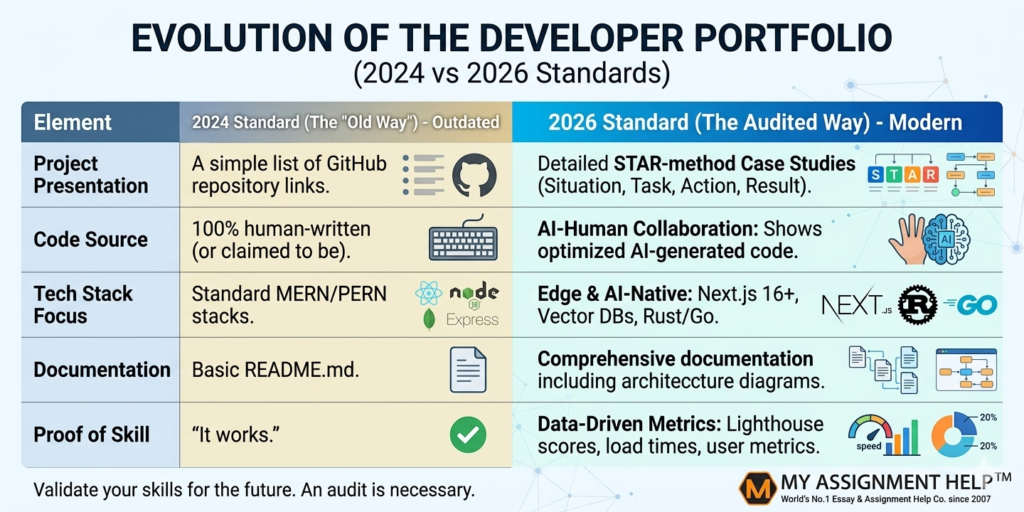
In 2026, a list of GitHub links is the bare minimum. Recruiters now prioritize context over syntax. An audit should begin by transforming your top three projects into comprehensive case studies.
Each project must follow the STAR (Situation, Task, Action, Result) method, but with a 2026 twist: explain how you used AI tools like GitHub Copilot or internal LLMs to optimize your workflow. Did you use AI for unit testing? Did you leverage it for refactoring? Showing that you can audit and improve AI-generated code is a top-tier skill in the current market.
2. Modernizing Your Tech Stack
The “standard” stack has evolved. To pass an audit in 2026, your portfolio should feature projects built with:
- Next.js 16+ or SvelteKit: For lightning-fast, edge-ready performance.
- Vector Databases: Implementation of Pinecone or Weaviate to show you understand semantic search.
- Rust or Go: For high-performance, system-level backend services.
- Agentic AI Frameworks: Projects utilizing LangGraph or similar frameworks to demonstrate multi-step AI reasoning.
If you are a student struggling to bridge the gap between classroom theory and these industry standards, seeking expert myassignmenthelp can provide the foundational clarity needed to master these complex systems. Utilizing professional Programming Assignment Help ensures that your academic projects are built on clean, scalable code that serves as a perfect base for your professional portfolio.
3. The “AI-Fluent” Audit
According to 2026 hiring trends, 84% of developers now integrate AI into their daily workflows. Your portfolio must explicitly showcase your AI fluency.
- Prompt Engineering: Include a “Behind the Scenes” section in your projects detailing the prompts used to architect specific modules.
- Code Auditing: Show a “Before and After” of an AI-generated function that you manually optimized for security or performance. This demonstrates that you are the master of the tool, not just a passive user.
4. Accessibility and Performance Benchmarking
A 2026 portfolio is a product in itself. Audit your site’s performance using modern Core Web Vitals. Your portfolio should load in under 1.2 seconds and maintain a perfect 100/100 accessibility score.
Data Point: Research indicates that portfolios with a Lighthouse performance score below 90 see a 40% higher bounce rate from technical recruiters.
5. Personal Branding and Narrative
Beyond technical skills, the 2026 market values your “Engineering Identity.” This is often best expressed through a technical blog integrated into your site. Much like choosing the right personal essay topics can define a student’s academic voice, your technical blog posts define your professional authority. Use this space to discuss your philosophy on “Sustainable Software Engineering” or “Ethical AI.”
Key Takeaways for 2026 Portfolios
- Showcase AI Collaboration: Prove you can audit and enhance AI-generated code.
- Prioritize Case Studies: Move beyond “folders of code” to narrative-driven problem solving.
- Performance is Non-Negotiable: Ensure your portfolio site is a high-performance PWA (Progressive Web App).
- Focus on Edge & Cloud-Native: Highlight projects that use serverless architecture and edge computing.
FAQ Section
Q: Should I include “Simple CRUD” apps in my 2026 portfolio?
A: Generally, no. In 2026, basic CRUD applications are considered tasks that AI can perform instantly. Instead, showcase apps with complex state management, AI integrations, or real-time data streaming.
Q: What is the most important language to show in 2026?
A: TypeScript remains the bedrock, but proficiency in Rust (for performance) or Python (for AI orchestration) will set you apart in the 2026 job market.
Q: How often should I audit my portfolio?
A: In the current fast-paced tech cycle, a “Mini-Audit” should happen every quarter to ensure your dependencies are updated and your project descriptions reflect the latest industry terminology.
About the Author
Senior Content Lead, MyAssignmentHelp With over a decade of experience in technical communication and SEO strategy, our lead strategist focuses on bridging the gap between academic learning and 2026 industry requirements. Having mentored thousands of students in Australia, the US, and the UK, they specialize in translating complex data science and programming concepts into actionable career roadmaps.
References
- Deloitte (2026): Global Software Industry Outlook – The Era of Agentic AI.
- Gartner (2025): Tech Trends 2026 – The Rise of the AI-Native Developer.
- Stack Overflow Developer Survey (2025-2026): Evolution of the Professional Tech Stack.